

Hands in the mud
por Cecilia Rayén Guerrero Dewey
This story, winner of the VI edition of the Crónica Patagónica Award, was translated by Literary Translation students at the Facultad de Lenguas, Universidad Nacional del Comahue. They are: Luna Alegría, Emilia Álvarez, Camila Cisneros, Valentina Del Prete, Agustina Kaiser, Agustina Lowenberg, Lucila Paez, Luz Peralta, Gabriela Picavía, Celeste Properzi, Lucía Trovato and Valeria Tverde. The professors who coordinated and accompanied the process are Leticia Pisani and Estefanía Fernández Rabanetti.
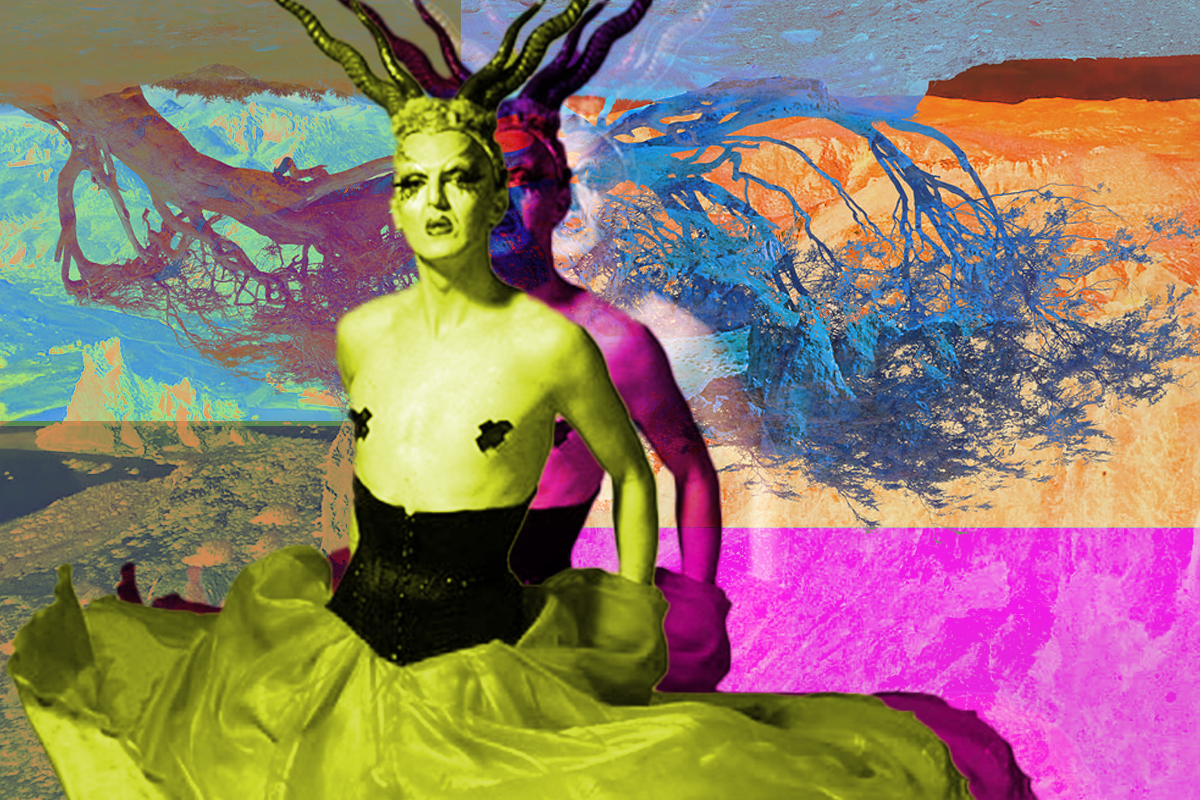
A headdress made of fake roses bought in Once, one of the cheapest neighborhoods in Buenos Aires; the white dress embroidered with red flowers that look like freshly painted lips; the kimono, black and silken; the sparkly, ultra-high heels. Oxiura Mallman is sitting in Susana Giménez’s living room, perhaps the queen of Argentina’s television. Oxiura is not alone, but with her Drag Queen sisters, with whom she shot the opening of the diva’s on-screen comeback a few days before. Susana explicitly requested that they be invited on the very first night, and now they are broadcast live, across the whole country. It is a triumph; each one of them knows it deep down in their hearts. They are having a blast. A little earlier, in the dressing rooms, they were finishing their make-up and Xuxa, the worldwide known superstar, knocked on their door to ask for a picture. It was they who had always admired her! And so there was laughter, nerves, and excitement.
On the other side of the screen, in the west-central region of Neuquén, near Carri Lil, in the Ruca Choroy river basin, Luis Fernando Pellao hears Oxiura talking on TV and says: “That is peñi Titi.” He then excitedly grabs his mobile phone and rushes out of the house. He runs up the back hill to get reception and call peñi Titi Ricciuto.
Oxiura does not pick up, she couldn’t have.
“Susana, please send some love to Aluminé, the town where I live. Everyone is watching.”
“Where is Aluminé?” the diva asks, spontaneous and genuine.
“Aluminé is in Neuquén, near the Andes range. They are all watching the show with their wood stoves on, surrounded by snow,” Oxiura replies, waving her hands like a play-pretend empress.
“Ay, mi amor! Sending lots of kisses to all of you.”
It is 2011, and it is the first time that Luis María Ricciuto, Titi, tells his hometown that he is Oxiura Mallman at night. He does not think about it at the moment; he’s over the moon about being on screen. But when the show finishes, he finds tons of messages and missed calls from his neighbors on his mobile phone, including peñi Pellao’s. He reads the messages carefully. One particular message puts a smile on his face. “Titi, my friend, are you with Susana Giménez? Tell her about me,” a paisano says. They all congratulate him and send him their love. Nobody judges him. It’s only then that he breathes with relief.
Seen in the deep
A few months later, he goes back to Aluminé. His legs are trembling, it is the first time he is going to face them after such a display. The town has not changed: It is the same one-story houses, the dirt roads, the flagstone facades, the echo of midday gatherings in the main square, the cloudless pale blue sky, the few cars creeping along. Everything follows its course like the transparent, almost shining river which flows between the foothills of the Andean range. Aluminé. A sparkling pot, light, the place where the blizzard gathers, a reflection of moonlight, where you can see in the deep. He knows Aluminé means all these things, depending on who you ask. He likes unraveling words, like when he was a child.
He talks about these things with his friend Lili Horst, the anthropologist. His sister introduced them in Titi’s early teens, and they immediately clicked. They both spoke the same language, always searching for meanings. He trusted her with his questions on nature and humanity, on what is invisible to the eyes, the small and big questions about all things; and she listened carefully, amazed and full of love for that unique teenager she loved instantly and still loves as a son.
Titi does not dare go out alone, now that he is the target of all questions. And so he asks Lili to join him and they walk together. They head towards the Juan Benigar Community Library, where she is the director. They walk entire blocks, passing by the small civic center, the storefronts, the main square. Walking arm in arm, they stop several times so that Titi can say hello to everyone. He has a radiant smile, wide eyes and those slightly childish and clumsy manners that characterize him every time he is not Oxiura, just another peñi, a brother. As the hours go by, fears fade away. It is easier to see in the deep: he is home.
Singing to the cows
In the past, far away from Aluminé, there was a first sky and other afternoons.
Luis María Ricciuto was born in Bolívar, province of Buenos Aires, in April 1976. His mom and dad lovingly called him Titi when he was a baby.
Back in his childhood, the house is quiet and the doors are closed. Titi looks for his mother’s nightgown in her dresser and lays it against his body to see how it looks; he then grabs a lace bra and two pairs of socks to stuff it. He lifts his head up, trying to catch any noises outside the room. Time seems to freeze during siesta in Bolívar. He rushes to try everything on: the nightgown goes all the way down to his ankles, and if he opens his arms, the sleeves look like wings. It’s like he could fly. He grabs Aunt Suni’s cork-soled shoes —those he secretly hid inside the nightstand— and climbs into them with his cotton socks still on. He checks the clock on the wall. He goes through the objects on the nightstand and finds his sister’s eyeliner. Without removing the cap, he draws a line over his eyelashes. In that brief moment of solitude in front of the mirror, confident and elegant on his heels, before anyone breaks the silence, before he has to, once again, become what others want him to be, he feels powerful.
During other siestas, he visits the cows in the neighboring field. They look at him with round, lost eyes, as if he were transparent. He talks to them, confides in them, and there are afternoons in which he even puts his shirt over his head as if it were a long and gorgeous head of hair and, using an imaginary microphone, performs his greatest show ever. He sings Joan Sebastián’s “Ponle agua fresca en un jarrón”, the song he listens to when he manages to tune in to Radio Colonia. The cows, silent and incapable of judging him, are his best audience. Without the terror of being discovered, it is in front of them that he creates his best memories.
He grew up understanding that happiness is about conquering moments. He stumbled —this he realized much later— upon the most frightening monster that haunts children. Without meaning to, he learned to listen to his body, to sense on his skin when he was safe and when he wasn’t. In Las Acollaradas Park, in Bolívar, he also learned to watch the birds and the sky, to observe his surroundings, the words for things, the shapes of trees, but above all, to respect animals. There, he was certain that, despite any danger, he was always safe.
He was a curious person, a reader, an observer. He went from being a child full of questions to a teenager with answers to share.
Woman of clay
Aluminé came sometime later. When he was 15, his parents told him they were moving south, to Patagonia. It was not a new place for him. They used to visit every summer after his sister married the son of a well-established local family. It was a difficult time for the agricultural sector, and the economic situation in Bolívar was not the best. His family had to sell the land, and just days later, his father found a house in Aluminé where they could start over. When a farm is sold, everything goes up for auction. Those days were rough. Titi watched his childhood slip away under the auctioneer’s hammer. After that, they loaded everything that was left into a trailer and headed south.
The new house welcomed him warmly from the very beginning. He already had some friends in town, like Lili Horst, her daughter Ana Julia and other children around his age, friends he had made in his previous visits. The land revealed new outlines: the landscape, the mountain, the sounds, the immensity. In Bolívar the wire fence seemed to take the infinity from the plains, but in Aluminé you could see the horizon and the air was filled with birdsong. It was not long before he took an interest in the Mapuche community —a large number of Aluminé’s population— and he could not stop asking about it.
“Gerónima is on ATC channel tonight; it’s the story of a Mapuche woman,” he told his mother one day.
They watched the film together. It had a lasting impact on him. It was a tragic story, directed by Raúl Tosso and starring the Mapuche artist Luisa Calcumil, that showcased the intercultural clash brought about by the winka’s oppression. “I don’t want to be given a hand, I want all hands off me,” screamed Gerónima. There was something about that pain that suffocated him, but also something he could understand.
Moved by what he saw, he started molding clay. He had never been allowed to play with Barbies and perhaps that was why he began creating his own women, his clay girls. He spent hours molding worn, weathered faces that he could easily recognize whenever he passed the Mapuche women on the street. He was just getting started, but his creations were decent, and a neighbor invited him to sell them in the Feria Franca, where locals offered their products.
He was setting up his stall when he saw a woman carrying loom-woven matras that reminded him of Gerónima.
Her name was Berta, she came from Ruca Choroy. Her face did not reveal an exact age; it was a timeless, endless stone. She was holding a girl in one hand and her matras in the other. She spoke Spanish because that was the way things were, but her mother tongue was Mapudungun, the language of the earth and the one she taught her daughters.
Titi approached her. There was something about her that captivated him. He asked her several questions, as was typical of him, and then invited her to have a meal at his house. Titi’s mother cooked delicious food for everyone, and they enjoyed the rest of the day together. Berta was very grateful for their kindness and invited him for a visit to Ruca Choroy, just 18 miles away, following the river. Weeks later, he convinced a friend to go with him and they tried to thumb a ride. But nobody ever went to Ruca Choroy, the house of the parrots, Mapuche ancestral territory. Now Titi was. Someone finally gave them a ride for a few miles, and then they continued on foot.

Back then, there were no concrete houses; they were all sheet metal shanties with wood scraps and burning stoves. They stopped at every shack they passed asking for directions.
“No! You have to keep going higher up.”
Berta’s shack was the last one, at the top, smoking, over the forest of pehuenes, almost touching the clouds. When she saw him, Berta opened the door and smiled. Titi entered her house, but he also entered into her heart and into a dimension of mud, hearth and hot soup. Everything in the forest was given a name and a reason. She taught him to look at the sky, to read the movement of the lake. She taught him that her people were the ones who had escaped from Tandil, Azul and Bolívar where the Argentinian army took them down with gunpowder and death. He learnt that Las Acollaradas Park was once a battlefield and back then, the birds did not sing.
His body felt he could take root there. Berta’s friendship not only became a home and a shelter, but also a commitment to the people he was getting to know. They lived as neighbors, and also as family.
The new Inca
In the times of Winka Malón, the so-called Conquest of the Desert, when the people fleeing from General Roca’s bloodthirsty army reached the regions of lakes Ñorquinco, Aluminé, and Ruca Choroy, they would hear the lonko, their leader, say: “Pun may, the night has fallen upon us, time to rest”. And due to a mistranslation, the area was named Pulmarí.
Before a new order was imposed with the arrival of the winka, the new Inca, those lands were used for grazing and raising livestock. With over 900 years of tangible signs of human presence on its back, these were territories of Indigenous and Hispanic trade which, for centuries, needed no government interference. This land told the story of the brave Rauquecura, the lonko of lonkos, “the most implacable and troublesome of Indigenous chiefs,” as The Standard, a newspaper of the time, described him, one who defended his people’s essence until his death. But from the late 19th century onward, Pulmarí came to symbolize the imposition of the Argentinian Government; it meant defeat in military terms, and resistance in real ones. The new conquistador had won, and the years that followed brought about a long period of dispossession and humiliation for the Mapuche people.
In 1987, through a decree issued by President Raúl Alfonsín, National Act 23612 was enacted, followed by Neuquén Provincial Act 1758. Both laws founded the Pulmarí Intergovernmental Organization, created to regulate the region’s natural resources and productive activities, in a collaborative effort between the federal government, the Argentinian Army and the Mapuche communities. However, what was meant to relieve the torturous history of the communities did not materialize; on the contrary, people were bogged down in the government’s new logic, and trapped in their wire fences. Until May 1995, when they said enough.
“Wait, pipe down, do you hear the sound of the kultrun?”
It was a cold fall night in Aluminé. Behind the darkness, the hills were bursting with the ocher of the ñire trees. Back then, the town had fewer streetlights and was quieter than it is now. Titi was coming out of a bar with his friends. “You’re obsessed,” one of the guys told him, but the sound grew louder. After some convincing, they walked in that direction. In the distance they spotted a bonfire lit up outside the offices of the Pulmarí Organization. “It was the kultrun,” Titi said. But they did not get any closer and went back home.
The next morning, they returned. The fire was still lit, and more people had started showing up. This time, they did not hesitate and walked all the way to the door.
“We are reclaiming our land. Are you with us or against us?” a man asked them, holding the door of the Pulmarí offices.
“We are with you.”
“Then come in.”
It took ten days to turn around a raging century. For most, it was a conflict; for others, it was an awakening, the end of an era marked by public displays of abuse, and an atrocious repressive process. The Pulmarí Rebellion divided the town into two groups: for and against. The school, the families, the street were all furrowed by an argument that was rooted deep.
“Titi committed himself body and soul to the cause,” says Lili Horst. It was not just about rhetoric or ideology. He was there, he slept there, he had a voice and spoke like an equal. He was not one of them, but no one ever questioned anything. He had chosen a side, perhaps long before. Every day, when he went to school, he would bring the discussion to the classroom, even if insulted by many of his classmates. It was time to talk about the Mapuche community, whether they like it or not.
Doña Juanita Puel, one of the papay, a community elder, called him “The Captive,” the only winka allowed to sit in their circle.
“To learn Mapudungun, you have to learn to listen to Mapudungun.”
Titi would gaze at his clay girls spellbound: Doña Juana Romero, Doña Ana María, Doña Emilia Nawelcura, Doña Rosa Catrileo. He listened so much that one day the words came out.
Now, looking back, he remembers the laughter in the moment of highest tension. That laughter was like a shield in that circle of doñas while, outside, the police were getting ready to repress and the court was preparing to prosecute the community for usurpation.
He remembers Doña Rosa recounting her arrival at Aluminé with nothing but the clothes on her back, after her house in Ñorquinco was set on fire. How many times was everything taken from her? The church gave her food and clothing, so she always went back, out of gratitude, to pray quietly in Mapudungun to the one on high, in the only language that He understands if spoken softly. “You see Titi?”, she said.
After 1995, the land was reorganized. The revolt of Pulmarí was an awakening, a key moment in the life of an entire community. The Mapuche had reclaimed their voice before an other; before a government that, since the Winka Malón, had turned them from landowners to peons by force of gunpowder and fire. The State could not –would not– recognize the roots of its own land. Since then, the real intercultural process began, an identity-forging process with no end in sight and in permanent tension. Concretely, this process fostered a policy dialogue between the communities and government-run organizations, which after a long, demanding journey, led to a number of achievements: the opening of high schools in Ruca Choroy and Lonco Luan, the construction of the Intercultural Health Center in Ruca Choroy, and the naming of a Mapuche president as the head of the Pulmarí Intergovernmental Organization.
Dignity prevailed, teaching Titi a life lesson which allowed him to set his questions in order and seek new answers. For a while, he left Aluminé.
Hundreds of cows
It was 1996. Ana Julia, Lili’s daughter, was leaving to study psychology in the city of Rosario, and she convinced him to join her.
“Titi knew how to look beyond the mountains,” Ana Julia says.
Those were good times. He had finally talked about his choices with his mom and dad. He felt so light-hearted that he only took what mattered: some clothes, fallen leaves from Ruca Choroy, romerillo, a Marité Berbel album, his kultrun, and a Luisa Calcumil cassette.
Rosario was a queer sunrise that fit him like a glove. He finished high school, started his theater studies, and joined a murga, a group of carnival performers. At some point, he thought about pursuing anthropology, but his friend Lili Horst told him not to waste time “dimming his beauty.”

He met Elektra Trash at a Pride Parade. A fierce Drag Queen who picked up trash on the street and made it shine on her body by a feat of alchemy. It was she who introduced him to the splendor of the wigs, the high heels, and the fake eyelashes. She helped him design his own Drag persona, which had begun to reemerge since childhood. The first time he wore eyeliner, not only did he recognize the kid who would playfully open the wings of his mom’s nightgown in front of the mirror, but she also felt empowered and allowed herself to be.
The city had embraced him. And let him flourish, crowned by carnival, confetti, murga, the Paraná River and Remanso Valerio. But a chapter had come to an end, and Rosario was starting to feel foreign as nostalgia grew inside Titi.
He returned to Aluminé in 2001 to put together a theater workshop. “Do you really want to perform or do you just want other people to go through catharsis with you?” his friend, actress Jorgelina Aruzzi, asked him. He was thrown off by this question, and he realized that it was not yet time to return to town. Having barely laid a hand on his luggage, he headed for Buenos Aires.
The city was brimming with spring vibes. From his balcony, Titi watched the birds in flight. He was at peace; he had a pleasant job in Jorgelina’s solo show and another at a local theater. There were no luxuries, but nothing to lose sleep over. The singing thrushes were louder than the noise of the city. “The moment I stop hearing them, I go back,” he swore to himself.
One cool, dry afternoon, he went window shopping along Santa Fe Street. He stood outside a hair salon, and something urged him to look in. Elektra Trash was sitting in front of the mirror, as immaculate as she had always been in his mind’s eye.
“You still have the heels? Then you’re working with me tonight, reina.”
So Titi goes back home, shaves his head and beard, and leaves for Elektra’s place in the intersection of Córdoba and Dorrego Streets. Colored wigs, tulle headdresses, brushes of all sizes, brand-new lipsticks, pheasant feathers, fairy dust: everything is on the table, like a great feast, and there is no rush. They glam up in front of the mirror for hours, the eyelashes curled, the fake mole, every face gem in its place. The two queens get a cheap ride and set off for the club.
The techno beats seep into the dressing room, Titi feels it in his chest. “It’s time,” someone says. At that moment, the doors swing open and she feels the heat of sweaty bodies, the flash of smiles lit by synthetic drugs and the music thundering over them like the shock wave of a bomb. Nothing stops them and they take the stage holding hands like sisters, wearing very high heels effortlessly.
She raises her arms and dances with her eyes closed. When she opens them, hundreds of cows look at her as she takes flight over a new, fertile field that now belongs to her.
Nightclubs, private shows, catwalks: she is a Drag Queen and she is in her element.
The Marí Marí parade troupe entered her life a few years later when they invited her to join them in the Gualeguaychú Carnival. In no time, she became the heart of the troupe, not only because of her performance at the parades, but also because she went the extra mile to improve things in this her new home for the summer. “She came to take the Carnival to the next level,” says Camila Gutierrez Bouvier, singer from Marí Marí. “It was a turning point in Gualeguaychú: we all wanted to improve when Titi was around.” First came Fobo, embodying the most primal fears, clothed in a splendid black gown. Then, he was Xangó: fire, deity, candomblé, orisha and negritude. Not only did he glam up with eyelashes, feathers and whips, he also embodied a meaning. But when he finished his performance, when Ash Wednesday came and he got back to reality, he remembered Aluminé with an inner feeling of longing that he shared with his close ones. Aluminé was the town that was promised.
Buenos Aires, Gualeguaychú and Aluminé are the same, he thought; territories that are never completely known. He had to choose where to take root. After a while, the noises of the city, the comings and goings of transport and the lack of horizon started to annoy him. One morning, he no longer heard the thrushes. It would not be like the other times when he was just visiting, like that day when he walked the town center with Lili saying hello to everyone after appearing in Susana Giménez’s show. This time he was determined to stay. He hung up the feathers and took a bus home. When he got off, he heard the chucao singing. “Hello, forest; hello, home.”
What makes you a peñi
It was 2015 when Titi returned to Aluminé. The day he arrived, Berta came down from Ruca Choroy to meet him. She had no idea that he was returning to town, no word from anyone or anywhere had reached her ears. There was no need; she felt it deep down inside, and that was enough. A bond with a peñi needs no words.
Titi’s return to take root in this land marked a fundamental turning point in his life. He came back as the sovereign of his body and desire. He realized he had the power to negotiate, to insist, and to persist —and he saw political action as a tool for change.
The Municipality invited him to organize the celebration for Aluminé’s 100 years of institutional life —a challenge he gladly accepted, gaining a significant foothold in the public sector. As a public servant, he founded El Charrúa museum, a polyphony of voices that tell the story of a land embracing its roots, and the Quilque Lil nature reserve, an area that protects and enhances the value of the local flora and fauna. Just as he did when he was a teenager, Titi easily blended into Aluminé’s community dynamics, and even though his proposals were always disruptive, even though the feathers he would sometimes wear on his head to reunite with Oxiura would come as a shock, people never stopped seeing him as a peñi.
In 2022, he was appointed Undersecretary of Diversity Policies during the final stretch of Omar Gutiérrez’s eight-year term as governor of Neuquén. He took up the position and had to move to its capital city. It was not Buenos Aires, he was able to go out for a run on the bardas, the Patagonian inland bluffs, and play at identifying little birds or fox tracks to avoid getting lost in the concrete. Sometimes, on his way home, he would ask the driver to pull over so he could remove the dead hares from the road and prevent scavengers from getting hurt. “Honey, look at the bright side. I have gas,” he would say with a smile in the days of crisis, when criticism hit the hardest. And all the while, he tried to deal with the weight of accepting a position during a dying government’s final breath —of dealing with the meat grinder of power.
“We’re going to set the condor free! I’m so excited! I want to make a video, I don’t know… I’ve been thinking of leaving this whole undersecretary thing behind to start making content about protecting native species, you know? What do you think? I want to do it all,” Titi says with his feet dipped in the river that runs through Neuquén, the Limay. “You know, the Limay River originates in Lake Aluminé, not in the Nahuel Huapi; there are several historical records about that in the museum, I’m just telling it like it is,” he says, almost screaming with his porcelain-like voice, and busts out laughing.
A fox, a chimango, any creature: Titi rescued more than a dozen animals from human-inflicted wounds and helped them recover in his backyard.
“Maybe I’m feeling homesick for Aluminé. When I go back there, I’ll visit Berta. Sometimes I think she’s a sister, other times I think she’s my mother and that in her house, up in the clouds, I have them both: my mother who’s in heaven and her who’s walking the Earth.”
When Omar Gutierrez’s term finished, the new authorities asked Titi to be part of the administration as the head of the Department of Intercultural Action. However, he was too far from home to see himself assuming that position.
“What I want is to bury my hands in the mud.”
Titi went back. He put down his travelling bags and started to clean up. He tidied everything up quickly and started modeling a huge pot with clay that he brought from his backyard. The next day, he fired it at a trade school. It did not break or crack; it was enormous and perfect. On his way home, he bought some vegetables and beef shank and cooked soup for dinner.
The following morning, he got into the car and drove to Ruca Choroy without knowing whether Berta was there or in the veranada, the summer grazing, with her animals. He found her while she was gathering twigs in the forest.
“Hi, honey!”
Just for a few months now, he has been representing Neuquén as a member of the Pulmari Intergovernmental Organization board, which ratified Lonko Daniel Salazar as their president.
“History has its twists and turns,’’ he says with a lively and genuine smile while he keeps the cows from grazing in the backyard.
Being at home means putting things straight.
It is resting in simple things: preparing an ointment for the soul, feeling gratitude for the soup, lighting the fire. Whether glammed up as Oxiura Mallman or Xangó, in his role as a public servant or as peñi Titi, it is as simple as kneeling on the earth to share life, standing on the same margin, becoming a peñi once again.
___
Translators’ note: When a culture-specific term (peñi, winka) appears in italics, it is generally followed, between commas, by a gloss. If the term has already been glossed, it appears in roman type.